


Page 7 - ATEN Meeting Room Solutions Guide
P. 7
Trends in


 Meeting Rooms


 BYOD and Advances in Meeting Space Technology


 Just as newly emerging technologies have changed every aspect of our lives, the tools we use in our meeting room
 environments have moved on from the days of chalk board presentations and bored employees in drab, dimly-lit
 function rooms. And as IT becomes more consumer-oriented, personal tools are also becoming work tools.

 BYOD (Bring Your Own Device) is a concept that embodies the kinds of advances in meeting room technologies   Dynamic Participation and the Evolution of Global
 that implementers now have to take into consideration. While various studies indicate that BYOD improves user
 experience and productivity, there are also challenges to overcome with employees bringing their own computing   Collaboration
 devices, such as tablets, mobile phones and laptops, to use in the workplace. Not only do these devices need
 connectivity on the corporate network – which creates a need for extra security as these devices have been previously   With ever-increasing advances in collaborative and interactive technologies and the need to work with people all
 unmanaged by network administrators – but there are also further implications in the meeting room scenario.  around the world, the evolving demands of corporate meeting environments and the expectations of what needs
            to be achieved in these spaces have paved the way for innovations that are specifically tailored to meet productivity
 Meeting participants are likely to need to share and sync content from their devices, so solutions must facilitate   and goal-driven targets.
 interoperability by giving these participants a way to have all devices collaborate with each other. These interactive
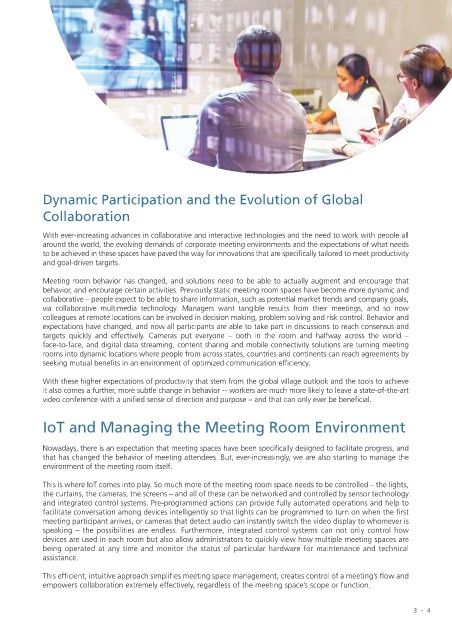
 technologies mean participants can seamlessly connect their own devices to large screen 4K displays and   Meeting room behavior has changed, and solutions need to be able to actually augment and encourage that
 projectors, and focus can switch effortlessly from one presenter to another with tracking cameras. In addition,   behavior, and encourage certain activities. Previously static meeting room spaces have become more dynamic and
 presenters can sync their presentations with the mobile devices of participants so they can contribute their own   collaborative – people expect to be able to share information, such as potential market trends and company goals,
 ideas both locally and remotely.   via collaborative multimedia technology. Managers want tangible results from their meetings, and so now
            colleagues at remote locations can be involved in decision making, problem solving and risk control. Behavior and
            expectations have changed, and now all participants are able to take part in discussions to reach consensus and
            targets quickly and effectively. Cameras put everyone – both in the room and halfway across the world –
            face-to-face, and digital data streaming, content sharing and mobile connectivity solutions are turning meeting
            rooms into dynamic locations where people from across states, countries and continents can reach agreements by
            seeking mutual benefits in an environment of optimized communication efficiency.

            With these higher expectations of productivity that stem from the global village outlook and the tools to achieve
            it also comes a further, more subtle change in behavior -- workers are much more likely to leave a state-of-the-art
            video conference with a unified sense of direction and purpose – and that can only ever be beneficial.


            IoT and Managing the Meeting Room Environment


            Nowadays, there is an expectation that meeting spaces have been specifically designed to facilitate progress, and
            that has changed the behavior of meeting attendees. But, ever-increasingly, we are also starting to manage the
            environment of the meeting room itself.

            This is where IoT comes into play. So much more of the meeting room space needs to be controlled – the lights,
            the curtains, the cameras, the screens – and all of these can be networked and controlled by sensor technology
            and integrated control systems. Pre-programmed actions can provide fully automated operations and help to
            facilitate conversation among devices intelligently so that lights can be programmed to turn on when the first
            meeting participant arrives, or cameras that detect audio can instantly switch the video display to whomever is
            speaking – the possibilities are endless. Furthermore, integrated control systems can not only control how
            devices are used in each room but also allow administrators to quickly view how multiple meeting spaces are
            being operated at any time and monitor the status of particular hardware for maintenance and technical
            assistance.

            This efficient, intuitive approach simplifies meeting space management, creates control of a meeting’s flow and
            empowers collaboration extremely effectively, regardless of the meeting space’s scope or function.


                                                                                                              3      4

